
The cavity wall insulation guide
Cavity wall insulation in Ireland.
A suitable cavity can be filled without changing the look of your home. Start with a survey, then compare the work, costs and grants.
View sources & review details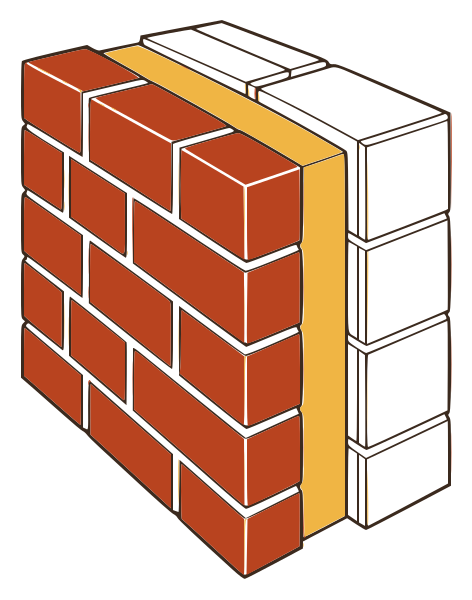
The essentials
Start with the wall survey
- Cavity wall insulation fills the gap between the two layers of an outer wall, by injection from outside.
- Check whether you have a cavity before you plan, because a solid wall needs a different job.
- SEAI's Better Energy Homes grant (the "standard grant") is a fixed amount by house type. Some people on certain benefits, and some landlords, get a higher grant instead.
- To get the grant, all the outside walls of your house must be insulated.
Cavity wall insulation fills the gap between the two layers of an outer wall. SEAI (the Sustainable Energy Authority of Ireland, the state body that runs the grants) pays a grant for it through its Better Energy Homes scheme, which covers single upgrades like this one. Insulation can be blown into that gap through small holes drilled from the outside, then the holes are filled. It leaves the look of the house unchanged and, says SEAI, does not need planning permission. For the wider picture of grants, see SEAI insulation grants explained.
Do you have cavity walls?
A contractor should survey the walls before quoting. Some pointers before they visit:
- Look at the brickwork on the outside. In a solid wall, some bricks are laid end-on, showing their short end. A cavity wall is normally laid with the long faces showing, in a regular pattern.
- Wall thickness alone cannot confirm a cavity. Ask the contractor to establish the wall construction during the survey.
- Check for existing insulation. A previous grant, or a note in a BER certificate, can tell you.
- Find a registered contractor (see choosing a contractor) and ask them to inspect the cavity before they quote. They should confirm it is open and wide enough, and that it is dry and not already filled.
The Energy Saving Trust’s brickwork examples show these typical patterns. Render, plaster or cladding can hide them, and a survey must confirm the construction.
SEAI excludes “traditional buildings”, typically solid masonry built before 1940, from these wall grants. If yours is one, ask SEAI on 01 808 2100 whether your house counts before you plan. SEAI points owners of these houses to its Traditional Homes Pilot, a separate scheme for traditional buildings that the individual wall grants do not cover. An older house probably has a solid wall: see external wall insulation.
What goes into the cavity
Several materials are used to fill an existing cavity. A common one is expanded polystyrene (EPS) beads: small beads blown in through the drilled holes, usually mixed with a binder so they stay in place. NSAI (the National Standards Authority of Ireland) publishes Agrément certificates for such systems, for example Envirobead and Korefill. A certificate sets out the conditions the product was assessed for, such as the cavity width and wall height. Other loose-fill materials exist, so do not assume beads. Ask the contractor:
- Which product they propose, and for its Agrément certificate. Check that the certificate is current with NSAI and covers your kind of wall. An Agrément certificate means NSAI has assessed the product for stated uses and conditions; it is not a guarantee of the installer’s work. Also check it covers how exposed your site is to wind-driven rain, which is what the certificates mean by site exposure.
- How they will check that the cavity is wide enough, clear of rubble and dry before they fill it.
- How they will confirm after the work that the cavity has been filled evenly, and what they do about any gaps.
When cavity wall insulation is not the right fix
- The wall is solid, or there is no clear cavity.
- The cavity is already filled with a previous insulation. A cavity that is only partly filled is not automatically ruled out: some products are certified for partly filled cavities if enough clear width remains and other conditions are met (the Envirobead certificate has a clause on this). Whether yours qualifies depends on the product and a survey, so ask the contractor to assess it and show the certificate wording.
- The walls are damp or the outside is in poor condition. Repairs should come first, because insulation in a wet cavity can make things worse. Ask the contractor how they judge this and what they do if the survey finds a problem.
- Part of the house has a cavity and part does not. The grant needs every outside wall done, so you may need a different insulation type for the rest, and SEAI pays only for the type covering the greatest wall area.
What it costs and what the grant pays
SEAI’s median costs for completed work, with the standard grant, are in the table under “What it has cost, and what the grant covers” further down this page. Cavity wall insulation usually costs less than internal wall insulation or external wall insulation; see those guides for their costs.
Applying for the grant
Choose a registered contractor first (SEAI’s contractor search) and get their SEAI registration number. Apply to SEAI before work starts or any materials are bought, using their name and number. After the work a BER assessment (an energy rating certificate) is done, and SEAI then pays the grant. Keep the contractor’s safety file (the documents SEAI requires your contractor to give you for inspection; for wall insulation it includes the product’s Irish Agrément certificate. SEAI’s guidance lists the contents in section 4.2). The steps are in the grants guide. The higher grant is for people on qualifying welfare payments and for landlords with an active Housing Assistance Payment (HAP, a state rent support) or Rental Accommodation Scheme (RAS, a council-arranged tenancy) letting; SEAI’s wall insulation grants page sets out the conditions. Insulating the attic as well as the walls stops heat escaping through the roof; see the attic guide. Follow the grant eligibility check to see whether you qualify for the higher grant, then use the application steps above.
What it has cost, and what the grant covers
These are SEAI's median costs for work completed under its schemes, January to June 2026, taken from the costs contractors reported when the grant was paid. Half of the jobs cost less than the median and half cost more, so use it as a rough guide, then get quotes.
Medians for different house types can come out in an unexpected order because each is drawn from a different mix of jobs. SEAI does not say whether the costs include VAT, so ask each contractor whether their quote does.
The grant amounts are SEAI's Better Energy Homes figures, checked on 29 October 2026. The grant is a fixed amount and never more than you spend: your final cost after the grant is your quote minus the grant. SEAI normally pays the grant to you after the work and paperwork are complete, unless your registered contractor agrees to deduct it from your price, so you may pay the full quote first.
On a narrow screen, scroll the table sideways to see every column.
| House type | Median cost | Standard grant |
|---|---|---|
| Detached | €2,350 | €1,800 |
| Semi-detached or end of terrace | €1,585 | €1,300 |
| Mid-terrace | €1,250 | €850 |
| Apartment | €1,036 | €700 |
Higher grant
Some homeowners qualify for a higher attic or cavity wall amount, which replaces the standard amount instead of adding to it. The higher amount is for people receiving a qualifying welfare payment, for landlords with an active Housing Assistance Payment (HAP) or Rental Accommodation Scheme (RAS) tenancy, and, for the attic only, for first-time buyers of an existing home who bought it on or after 1 January 2025. SEAI lists the qualifying payments, with their conditions, on its page for homeowners receiving certain Department of Social Protection payments. The attic and wall eligibility rules are on SEAI's attic insulation grant page and wall insulation grant page.
On a narrow screen, scroll the table sideways to see every column.
| House type | Attic: welfare, HAP/RAS or first-time buyer | Cavity wall: welfare or HAP/RAS |
|---|---|---|
| Detached | €2,500 | €2,300 |
| Semi-detached or end of terrace | €1,900 | €1,700 |
| Mid-terrace | €1,800 | €1,100 |
| Apartment | €1,400 | €900 |
Common questions
Can I add more wall insulation later if I already have a cavity grant?
In some cases. SEAI allows a second, different type of wall insulation (internal or external) after a cavity wall grant. It does not allow a second type after an external wall grant. Ask SEAI whether your house qualifies.
Does cavity wall insulation need planning permission?
No. SEAI says planning permission is not required for cavity wall insulation. External wall insulation can need it; see the external wall guide.
What if only part of my house has a cavity?
SEAI requires all outside walls to be insulated. When a house needs more than one type of wall insulation, the contractor must record it, and SEAI pays the grant for the type covering the greatest wall area.
Work out your own numbers
- Grant total: add up what each SEAI route pays for your upgrades.
- Which grant route: five questions to find where to apply first.
Sources and review
Sources were last checked on 29 October 2026. The review checks published guidance; ask a contractor to survey and design the work for your home. Cost figures state the period covered. Grant amounts show their check date.
- Identifying exposed brick wall patterns
- Envirobead Agrément certificate 08/0302 (NSAI)
- Korefill Agrément certificate 07/0293 (NSAI)
- Wall insulation (SEAI)
- Better Energy Homes Scheme Homeowner Application Guide (SEAI)
- Better Energy Homes Contractor Code of Practice v1.20 (SEAI)
- Median costs of individual energy upgrades, January to June 2026 (SEAI)