
The internal wall insulation guide
Internal wall insulation in Ireland.
Keep the outside as it is and insulate from within. Understand the room space, disruption and moisture checks before choosing dry-lining.
View sources & review details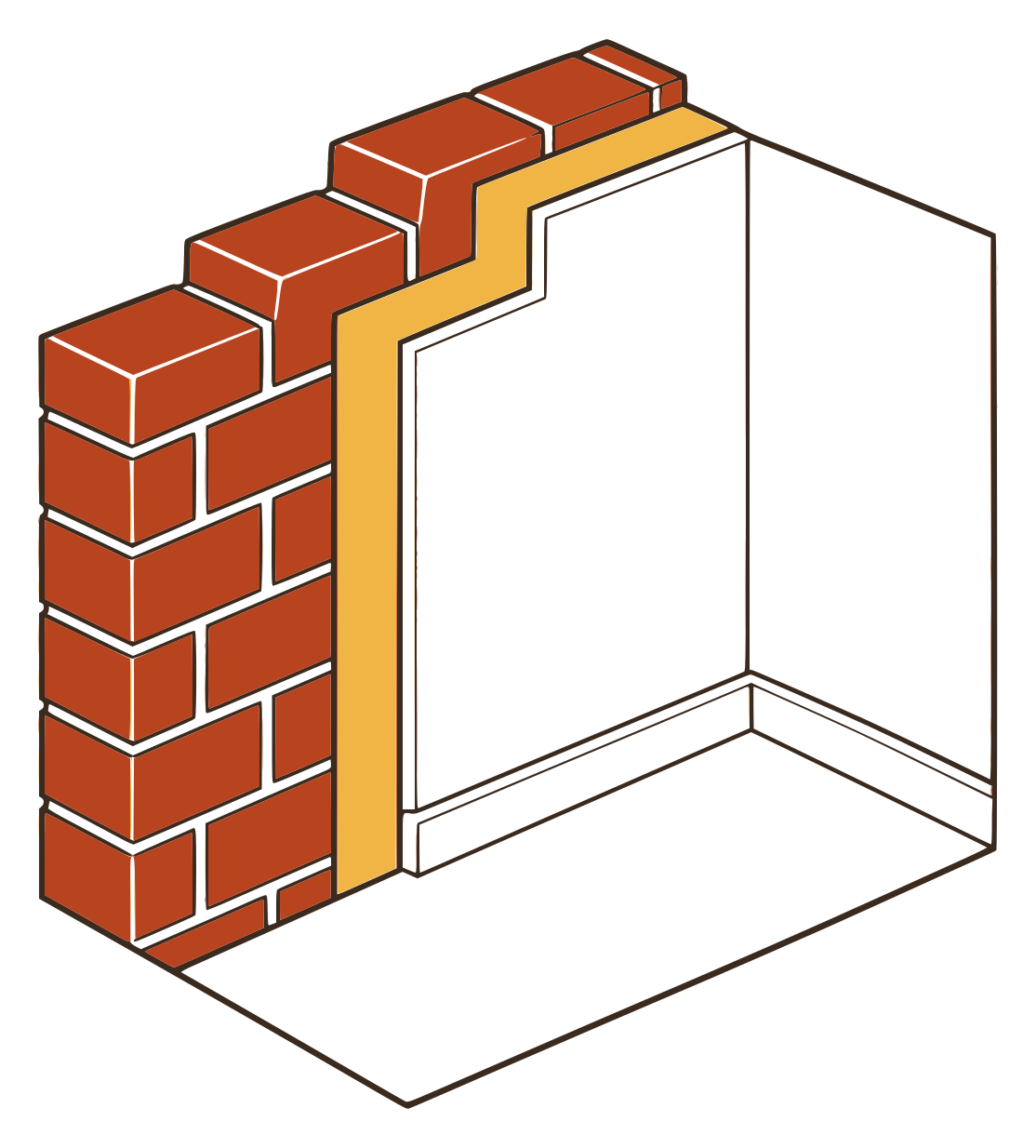
The essentials
Before you line the walls
- Internal wall insulation fixes insulation boards to the inside face of the external walls, then finishes them with plasterboard. Nothing changes on the outside of the house.
- SEAI, Ireland’s state energy agency, says it does not need planning permission, but you lose a little floor area in every room where it is fitted.
- The grant is a fixed amount by house type and covers only part of the cost.
- To get the grant, every external wall that needs insulating must be done; check with SEAI if some are already insulated or are extensions.
Internal wall insulation (also called dry-lining) fixes insulation boards to the inside of the external walls and covers them with plasterboard. It is used where the outside cannot be changed, for example because of planning limits or a brick or stone face you want to keep, or where there is no usable cavity. For the grant routes, see SEAI insulation grants explained.
What the work involves
Each room is worked on in turn. Skirting boards, sockets, switches and radiators are removed or moved, and the surfaces at the sides of window openings are built out or adapted to meet the thicker wall. The boards are then fixed to the wall, and the surface is plastered and redecorated. You can stay in the house, but the rooms being done are unusable for a while, and furniture has to move.
Things to check with the contractor before you accept a price:
- Room size. The boards make each wall thicker, so every room loses a few centimetres of floor space. Ask for the thickness being fitted and check tight rooms such as bathrooms and stairs.
- Electrics and plumbing. Sockets, switches and radiator pipework need moving. Ask whether that is in the price, and who does it.
- Damp. Ask the contractor to find and fix the cause before insulating. This includes moisture rising up the wall from the ground (rising damp) or water getting in from outside (penetrating damp). Insulation fitted over damp walls can trap moisture.
- Ventilation. A tighter, warmer house needs enough ventilation to avoid condensation. Ask what the contractor allows for.
- Redecoration. Find out whether new paint or wallpaper is included.
Condensation and moisture behind the boards
Fitting insulation on the inside leaves the old wall colder in winter than it was, because less heat now reaches it. Warm, moist room air that gets through or round the boards can then meet that cold surface and condense, which can leave damp or mould that you cannot see. The risk is higher in a solid wall, and in a wall that is already wet. Researchers modelling solid brick walls found that the risk depended on the combination of insulation material and any vapour control layer (a membrane limiting moisture passing into the wall): in one UK government study (DEEP moisture risk report) a vapour-open material carried a lower modelled risk than a plastic foam behind a vapour-tight membrane. (Vapour-open means moisture can pass through the material slowly; vapour-tight means it largely cannot. A solid wall is one with no cavity, built of one thickness of brick, stone or block; a cavity wall has two layers with a gap between.) A conservation overview (Building Conservation) notes that the membrane is standard practice but questioned for traditional solid walls. There is no single right answer for every wall, so ask for a design, not just a price.
What to ask the contractor to put in writing:
- Which insulation, thickness and membrane (if any) they will use on your type of wall, and why.
- How they judged whether the wall is dry enough, and what they did about any damp, leaks or failed gutters found first.
- How they will seal edges, sockets and joins so room air does not reach the cold wall.
- What ventilation the room will have afterwards.
- Whether they have assessed the condensation risk for your wall, for example by a calculation or modelling method, and who is responsible if damp appears.
Compared with the other wall options
External wall insulation keeps room sizes unchanged, but it changes how the house looks, may need planning permission and usually costs more than internal insulation. External wall insulation is the choice when you cannot spare the room space or live with the disruption inside. Cavity wall insulation is the cheapest, but only if your walls have a suitable cavity. Internal insulation is usually the answer when the wall is solid and the outside must stay as it is, though solid walls built before 1940 (traditional buildings) are excluded from the grant: ask SEAI on 01 808 2100 whether your house counts. SEAI points owners of these houses to its Traditional Homes Pilot, a separate scheme for traditional buildings that the individual wall grants do not cover.
Costs and the grant
The grant is a fixed amount by house type, not a share of the price. The table under “What it has cost, and what the grant covers”, further down this page, shows SEAI’s median cost for finished jobs next to the grant, so you can see the gap you pay yourself. Your own quote will differ with the size of the house, the number of walls and the finish. Use the grant eligibility check below for your house.
Who can claim the grant
SEAI needs the home built and occupied before 2011, a contractor registered with SEAI, and approval before work starts or any materials are bought. Every external wall must be insulated. If you have had a cavity wall grant, a second, different type of wall insulation may be allowed. If you are planning several upgrades together, compare the One Stop Shop route (SEAI’s service where one company manages several upgrades together) in the grants guide. Next: read how to choose an insulation contractor, get quotes, then apply to SEAI for approval before work starts.
What it has cost, and what the grant covers
These are SEAI's median costs for work completed under its schemes, January to June 2026, taken from the costs contractors reported when the grant was paid. Half of the jobs cost less than the median and half cost more, so use it as a rough guide, then get quotes.
Medians for different house types can come out in an unexpected order because each is drawn from a different mix of jobs. SEAI does not say whether the costs include VAT, so ask each contractor whether their quote does.
The grant amounts are SEAI's Better Energy Homes figures, checked on 29 October 2026. The grant is a fixed amount and never more than you spend: your final cost after the grant is your quote minus the grant. SEAI normally pays the grant to you after the work and paperwork are complete, unless your registered contractor agrees to deduct it from your price, so you may pay the full quote first.
On a narrow screen, scroll the table sideways to see every column.
| House type | Median cost | Standard grant |
|---|---|---|
| Detached | €8,600 | €4,500 |
| Semi-detached or end of terrace | €9,843 | €3,500 |
| Mid-terrace | €9,804 | €2,000 |
| Apartment | €5,736 | €1,500 |
Common questions
Do I need planning permission?
SEAI says planning permission is not required for internal or cavity wall insulation. Check with your local authority if your home is a protected structure or in an architectural conservation area.
Can I have it if I already got a cavity wall grant?
Yes. SEAI allows internal wall insulation as a second, different type of wall insulation after cavity wall insulation. After an internal wall grant, SEAI allows only external wall insulation as a second type.
Can I insulate only the cold rooms?
Not for the grant. SEAI needs every external wall of the home fully insulated, in every room, not just the cold ones.
Is it covered for solid stone or pre-1940 houses?
SEAI excludes "traditional buildings", typically solid stone or brick built before 1940, from these wall grants. If yours is one, ask SEAI on 01 808 2100 whether your house counts. SEAI points owners of these houses to its Traditional Homes Pilot, a separate scheme for traditional buildings that the individual wall grants do not cover.
Work out your own numbers
- Grant total: add up what each SEAI route pays for your upgrades.
- Which grant route: five questions to find where to apply first.
Sources and review
Sources were last checked on 29 October 2026. The review checks published guidance; ask a contractor to survey and design the work for your home. Cost figures state the period covered. Grant amounts show their check date.