
The external wall insulation guide
External wall insulation in Ireland.
A warmer layer around your home, with a new finish outside. Plan the wall details, permission checks and budget before you agree a quote.
View sources & review details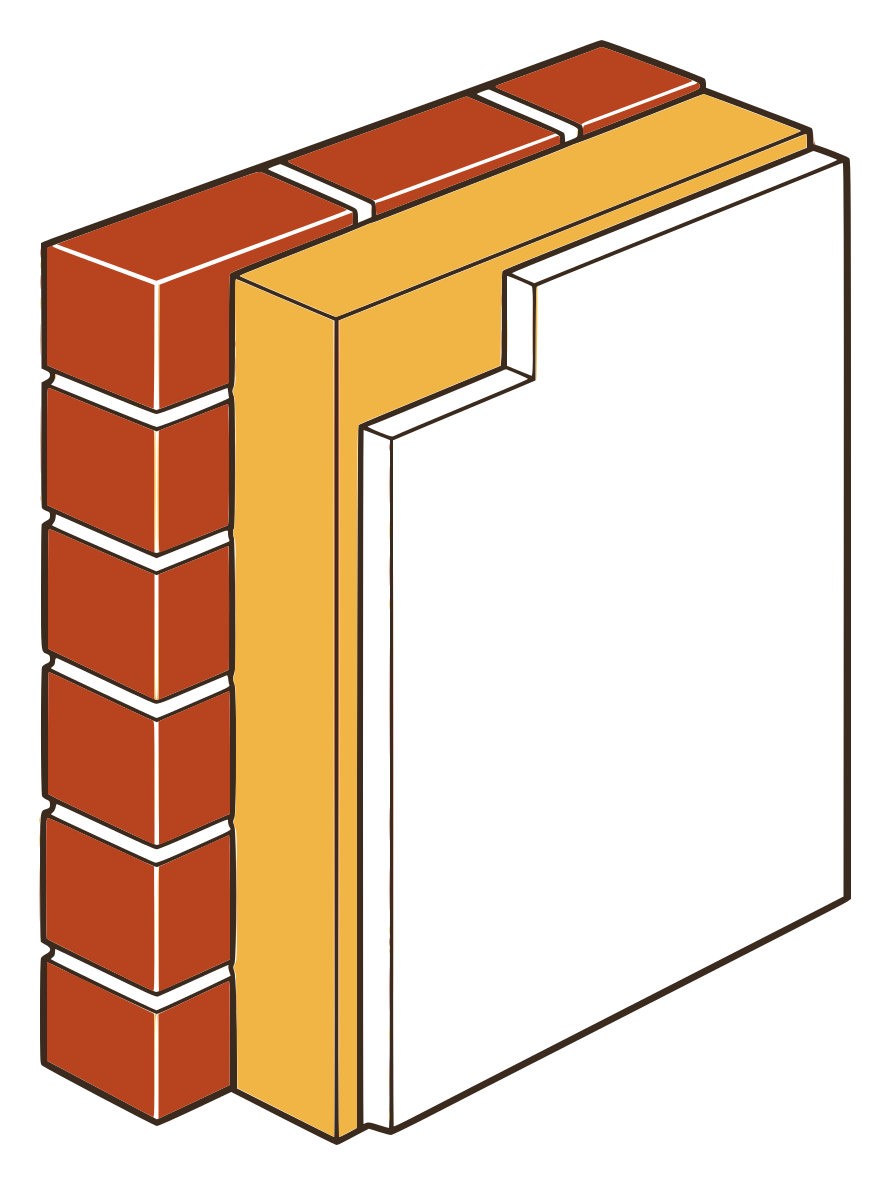
The essentials
Before you change the outside
- External wall insulation wraps insulation and a new render around the outside of the house. It is the most expensive wall option and has the largest grant.
- It can need planning permission. Ask your council's planning office before you apply for the grant.
- If the electricity cable or meter is on an outside wall, ESB Networks may need to move it, which can cost money and add delay.
- The grant is a fixed amount and covers only a share of the cost.
External wall insulation fixes insulation boards to the outer surface of the walls and covers them with a new render. It suits solid walls and houses where cavity filling is not possible, it keeps the room sizes as they are, and it changes how the house looks. For grants from the Sustainable Energy Authority of Ireland (SEAI), see our grant guide.
What the work involves
A contractor puts up scaffold, fixes insulation boards to every external wall, reinforces them and applies a render finish (the outer coat of plaster-like material over the boards). Details around windows, doors, pipes, gutters and the roof edge take time. Expect scaffold around the house for the duration, noise and dust, and limited access to windows and doors while it is up. Ask the contractor for a written timetable of the work.
Things to check with the contractor before you accept a price:
- Window sills and the side edges of window openings (cills and reveals). The wall gets thicker, so sills may need extending or replacing. Installers often price this separately. Also ask whether the quote includes making good, meaning repairing and redecorating anything disturbed, such as paths, gutters and paintwork around the walls.
- Pipes, vents, meter boxes and the electricity supply. If the electricity cable or meter is on an outside wall, ESB Networks may have to move it (a “service alteration”) before the insulation goes on, which can have fees and cause delay. Ask the contractor whether yours is affected, and contact ESB Networks well before work starts.
- Repairs. Cracks, damp patches and loose render should be sorted first.
- Finish and colour. Ask what render finish is included and whether it is guaranteed. Ask for the product’s Irish Agrément certificate (NSAI’s assessment of the system for stated uses), which SEAI requires in the contractor’s safety file (the documents your contractor must give you for inspection; SEAI’s guidance lists them in section 4.2).
The S.R. 54 retrofit code, section 7.3.2.3 (printed pages 100–105), covers the survey, services and reinforced render, including protection at exposed edges. Your contractor must follow the chosen system’s certification and installation details.
Planning permission
SEAI notes that external wall insulation may need planning permission, and tells you to contact your local authority before work. This is the main difference from cavity and internal insulation, which SEAI says do not need planning permission.
Since 27 July 2026 there is a specific exemption for insulating a house, in Class 63 of the planning regulations (S.I. 341/2026, page 3). As that instrument sets it out, the added insulation and finish may project no more than 150mm at the front, rear or gable of the house, must not extend onto or over a public road, and must look compatible with the house and its neighbours. Check the exact wording and any conditions in the instrument itself. The exemption does not cover everything: protected structures, houses in an architectural conservation area and other restricted buildings are treated differently, so ask the council whether your house is one of them. Boards that would go beyond your own boundary, for example onto a footpath or a neighbour’s land, need separate consent from the landowner or council; that is not part of this instrument. If the work does not fit the class, the older general test below applies.
That general test is why the front matters: the Planning and Development Act 2000 (section 4(1)(h)) treats works that only improve or alter a building as exempt from permission only if they do not materially affect its external appearance in a way that makes it inconsistent with the character of the building or of neighbouring buildings. Changing a street-facing wall’s finish, colour, window reveals and eaves is the likeliest way to cross that line. Under that general test, councils decide case by case, and older published planning decisions on front-elevation insulation went both ways, depending on how closely the new finish matched its neighbours. Sides and rear walls that cannot be seen from the road are less likely to be an issue, but SEAI’s advice is still to ask. Do not assume that a neighbour’s job, or a general exemption, applies to you. What to do: ask your council’s planning office, or ask for a section 5 declaration, a formal council decision on whether the work is exempted development. Give it drawings or photographs of the front, the proposed finish and colour, and how the boards sit at the window openings, eaves (where the roof edge overhangs the wall) and cills. Do this before you apply for the grant. Planning rules are set by law and change; this section is not legal advice.
Costs and the grant
The grant is the largest of the individual wall grants, and the work is the most costly. Two sources follow in the sections further down this page: SEAI’s median costs for finished jobs, and one installer’s published examples. Next: get at least two written quotes from SEAI-registered contractors (see choosing a contractor), then apply for approval before work starts.
Who can claim the grant
SEAI needs the home built and occupied before 2011, a registered contractor, and approval before work starts or any materials are bought. Every external wall must be insulated; the front or back alone does not qualify. SEAI excludes “traditional buildings”, typically solid masonry built before 1940, from these wall grants, so ask SEAI on 01 808 2100 whether your house counts before you plan. SEAI points owners of these houses to its Traditional Homes Pilot, a separate SEAI scheme for traditional buildings that the individual wall grants do not cover. Better Energy Homes is SEAI’s grant scheme for single upgrades such as wall insulation; the One Stop Shop is for several upgrades together. If you are planning several upgrades together, compare the One Stop Shop route in the grants guide. If your walls have a cavity (a gap between the inner and outer layer), cavity wall insulation is cheaper.
What it has cost, and what the grant covers
These are SEAI's median costs for work completed under its schemes, January to June 2026, taken from the costs contractors reported when the grant was paid. Half of the jobs cost less than the median and half cost more, so use it as a rough guide, then get quotes.
Medians for different house types can come out in an unexpected order because each is drawn from a different mix of jobs. SEAI does not say whether the costs include VAT, so ask each contractor whether their quote does.
The grant amounts are SEAI's Better Energy Homes figures, checked on 29 October 2026. The grant is a fixed amount and never more than you spend: your final cost after the grant is your quote minus the grant. SEAI normally pays the grant to you after the work and paperwork are complete, unless your registered contractor agrees to deduct it from your price, so you may pay the full quote first.
On a narrow screen, scroll the table sideways to see every column.
| House type | Median cost | Standard grant |
|---|---|---|
| Detached | €26,500 | €8,000 |
| Semi-detached or end of terrace | €23,219 | €6,000 |
| Mid-terrace | €14,000 | €3,500 |
| Apartment | €11,300 | €3,000 |
One installer's published examples
An installer publishes these project prices for stated wall areas. They include VAT and are before any grant. The usual scope is fitting, materials, scaffold and an ordinary render. Cills, repairs and awkward detailing can add to the price. Treat them as illustrations, not as quotes for your house.
On a narrow screen, scroll the table sideways to see every column.
| House | Wall area treated | Published price range |
|---|---|---|
| Terraced house | 80 m² | €8,800 to €12,800 |
| Detached house | 200 m² | €22,000 to €32,000 |
| Three-bedroom semi-detached | 120 m² | €13,200 to €19,200 |
Common questions
Do I need planning permission?
Sometimes. Since 27 July 2026 a specific exemption (Class 63) covers house insulation within set limits, and otherwise the general rules apply. SEAI tells homeowners to ask the local authority before work starts. Ask your council's planning office: "Does external wall insulation on my house need planning permission?"
Can I have it if I already got a cavity wall grant?
A previous cavity or internal wall insulation grant does not automatically rule you out. Ask SEAI on 01 808 2100 to confirm that your home meets the conditions for an external wall grant before you apply. Once you have had an external wall grant, SEAI allows no other type of wall insulation grant.
Can I insulate just the front or back wall?
Not for the grant. SEAI needs every external wall fully insulated, so the front or back alone does not qualify.
Work out your own numbers
- Grant total: add up what each SEAI route pays for your upgrades.
- Which grant route: five questions to find where to apply first.
Sources and review
Sources were last checked on 29 October 2026. The review checks published guidance; ask a contractor to survey and design the work for your home. Cost figures state the period covered. Grant amounts show their check date.
- Code of practice for energy-efficient retrofit, section 7.3.2.3 (S.R. 54)
- Planning and Development Act 2000, section 4 (Irish Statute Book)
- Class 63, external wall insulation of houses (S.I. 341/2026, Dublin City Council copy)
- Traditional Homes Pilot (SEAI)
- Wall insulation (SEAI)
- Better Energy Homes Scheme Homeowner Application Guide (SEAI)
- Median costs of individual energy upgrades, January to June 2026 (SEAI)
- External wall insulation cost in Ireland (Isotherm)